Shoulder pain is one of those problems people tend to brush off. You tell yourself it’s just a sprain, it’ll settle with rest, or maybe some balm and a few days off the gym will sort it out. Sometimes that’s true. But shoulder pain can also be a sign of something that only gets worse with time – a torn rotator cuff, a dislocation that keeps recurring, or early-stage frozen shoulder – and waiting too long to see a shoulder surgeon in Surat can turn a simple fix into a much bigger, more complicated treatment.
Knowing when to stop self-treating and start seeing a specialist can save you months of unnecessary pain and a much longer recovery later. Here are 7 warning signs that mean it’s time to book an appointment with a shoulder surgeon in Surat, along with what usually causes them and what treatment might look like.
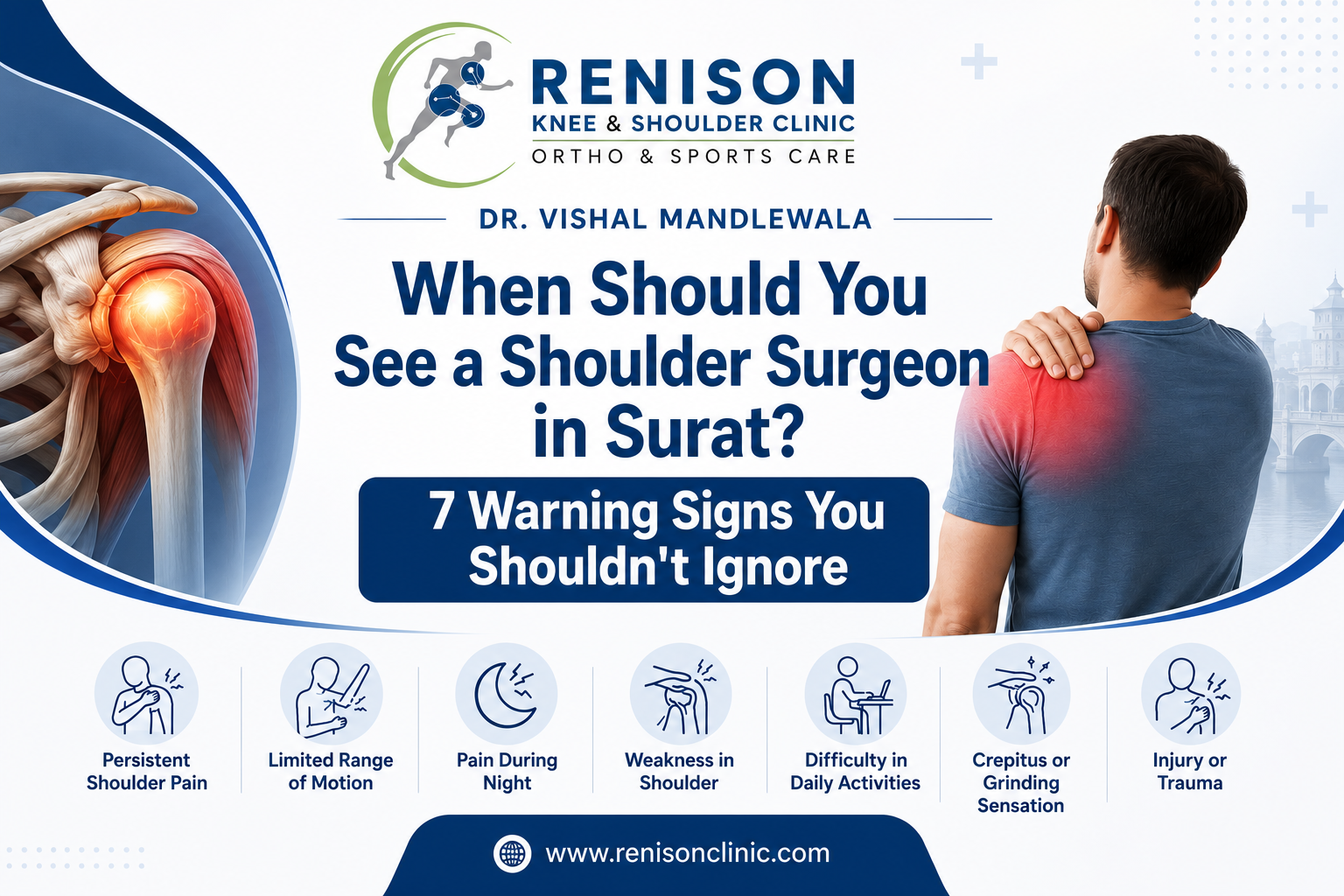
1. Shoulder Pain That Doesn’t Improve After 1-2 Weeks of Rest
Minor strains typically improve within a week or two with rest, ice, and avoiding overhead movement. If your pain hasn’t budged – or has gotten worse – after two weeks, it’s a signal that something more than a simple strain is going on. Persistent pain often points to rotator cuff inflammation, a partial tear, or an early impingement issue that needs a proper diagnosis rather than more waiting.
2. Your Shoulder Feels Weak or You Can’t Lift Your Arm Fully
Struggling to lift a bag, reach for a shelf, or raise your arm overhead is one of the clearest signs of a rotator cuff problem. A weak shoulder isn’t just inconvenient – it usually means the tendons responsible for stabilizing the joint aren’t functioning properly. This kind of weakness rarely resolves on its own and is one of the most common reasons patients are referred to a shoulder surgeon in Surat.
3. You Hear Clicking, Popping, or Grinding Sounds
Occasional clicking without pain is often harmless. But clicking or grinding accompanied by pain, catching, or a sensation that something is “stuck” in the joint can indicate cartilage damage, labral tears, or instability. These sounds are your shoulder telling you that the internal mechanics of the joint aren’t gliding the way they should.
4. Your Shoulder Has Dislocated More Than Once
A single traumatic dislocation, especially in younger patients, dramatically increases the risk of it happening again. If your shoulder has slipped out of place – or feels like it’s about to – more than once, this is a strong indicator that the shoulder’s stabilizing structures have been damaged. Recurrent dislocation is one of the clearest, most urgent reasons to consult a shoulder surgeon rather than continuing to “pop it back in” and hope it holds.
5. Stiffness That’s Getting Worse, Not Better
If your shoulder is progressively losing range of motion – you can’t reach behind your back, can’t fasten a bra strap, or struggle to comb your hair – and this stiffness is worsening month over month, it could be frozen shoulder (adhesive capsulitis). Left untreated, frozen shoulder can take a year or more to resolve on its own. Early diagnosis and the right treatment plan can shorten that timeline considerably.
6. Night Pain That Disrupts Your Sleep
Pain that specifically worsens at night or wakes you up is a red flag that orthopedic specialists take seriously. Night pain is commonly associated with rotator cuff tears and shoulder impingement, since lying down changes the pressure and position of the inflamed tissues. If your sleep is being disrupted by shoulder pain on a regular basis, it’s time to get it looked at.
7. The Injury Followed a Fall, Accident, or Sports Injury
Any shoulder pain that starts immediately after a fall, a road accident, or a sports collision should be evaluated promptly, even if it seems manageable at first. Fractures, ligament tears, and dislocations aren’t always obvious right after an injury – swelling and adrenaline can mask the severity. An X-ray or MRI evaluation from a shoulder surgeon in Surat can rule out (or catch early) anything that needs urgent attention.
What Happens When You See a Shoulder Surgeon
Seeing a specialist doesn’t automatically mean you need surgery. A thorough evaluation – clinical examination, and imaging such as X-ray, ultrasound, or MRI where needed – helps identify exactly what’s causing your symptoms. Many shoulder conditions, including early rotator cuff tears, tendinitis, and mild instability, respond well to physiotherapy, targeted injections, or activity modification. Surgery, including minimally invasive shoulder arthroscopy, is usually reserved for cases where conservative treatment hasn’t worked, or where there’s significant structural damage like a complete tear or recurrent dislocation.
At Renison Knee & Shoulder Clinic, Dr. Vishal Mandlewala works with patients to first understand the root cause of their shoulder pain before recommending a treatment path – surgical or non-surgical – that fits their lifestyle, age, and activity level.
Why Early Consultation Matters
The biggest mistake patients make isn’t ignoring shoulder pain outright – it’s waiting so long that a condition which could have been managed conservatively now requires surgical intervention. Rotator cuff tears that go untreated can enlarge over time. Recurrent dislocations can cause progressive damage to the labrum and cartilage. Frozen shoulder becomes harder to treat the longer it’s left. Consulting a shoulder surgeon in Surat early gives you more treatment options – not fewer.
If you’re experiencing any of the warning signs above, it’s worth getting a professional opinion sooner rather than later. Dr. Vishal Mandlewala at Renison Knee & Shoulder Clinic in Surat specializes in evaluating and treating the full range of shoulder conditions, from frozen shoulder and rotator cuff injuries to complex instability and dislocation cases.