Introduction
“Do I really need surgery?”
It’s the first thing most patients ask when they’re told they have a knee ligament injury. And it’s completely understandable – surgery sounds intimidating, the recovery sounds long, and the idea of a simpler, non-surgical solution is naturally appealing.
The good news is that not all knee ligament injuries require surgery. The challenging news is that some absolutely do – and delaying the wrong kind of treatment can cause significant long-term damage to your knee.
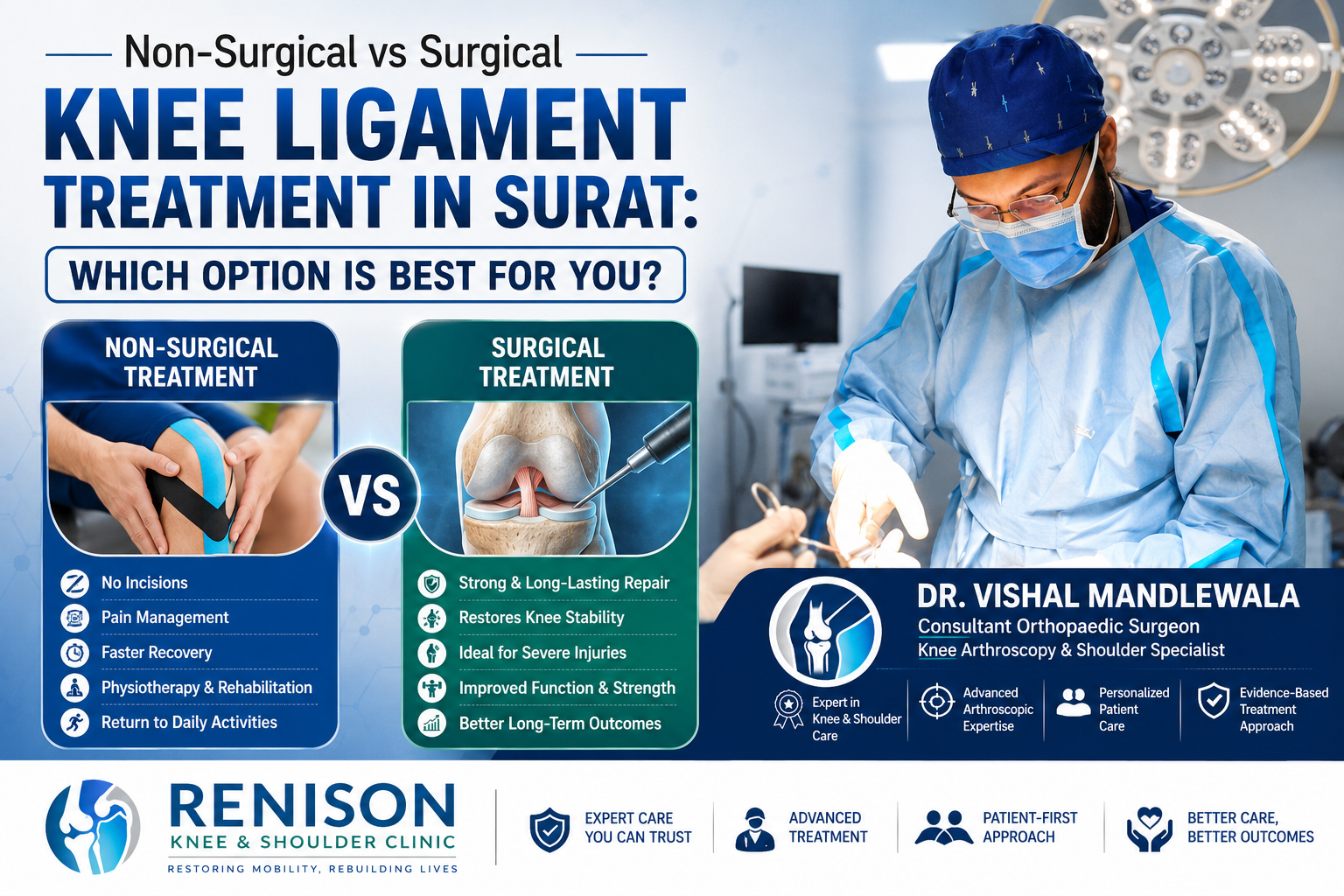
If you’re in Surat or South Gujarat and dealing with a knee ligament injury, Dr. Vishal Mandlewala at Renison Knee & Shoulder Clinic has helped hundreds of patients navigate exactly this decision. This guide – based on the same expert principles applied at the clinic – will walk you through both non-surgical and surgical options, help you understand what factors determine the right choice, and give you the clarity you need to have a productive conversation with your orthopedic surgeon.
Understanding Knee Ligaments
Your knee has four primary ligaments that work together to keep the joint stable:
- ACL (Anterior Cruciate Ligament) The most commonly injured knee ligament, especially in sports. It runs diagonally through the middle of the knee and controls rotational stability and forward movement of the shin bone.
- PCL (Posterior Cruciate Ligament) Located behind the ACL, the PCL controls backward movement of the tibia. It’s stronger than the ACL and injured less frequently – usually from direct impact (dashboard injuries in car accidents, for example).
- MCL (Medial Collateral Ligament) Runs along the inner side of the knee and resists inward stress. MCL injuries are common in contact sports and often heal well without surgery.
- LCL (Lateral Collateral Ligament) Located on the outer side of the knee. Less frequently injured, but significant when damaged.
Each ligament has different healing potential, and the treatment approach varies accordingly.
How Knee Ligament Injuries Are Graded
Before deciding between surgical and non-surgical knee ligament treatment in Surat, your doctor will grade the injury:
Grade | Description | Structural Damage |
Grade 1 | Mild sprain | Ligament stretched, fibres intact |
Grade 2 | Moderate sprain / Partial tear | Some fibres torn, joint slightly unstable |
Grade 3 | Complete tear | Ligament fully ruptured, significant instability |
Grade 1 and many Grade 2 injuries can often be managed without surgery. Grade 3 injuries – especially of the ACL – frequently require surgical reconstruction for active individuals.
Non-Surgical Knee Ligament Treatment in Surat: Who It Works For
Non-surgical treatment is a legitimate and effective option for the right patient with the right injury. Here’s what it involves and when it’s appropriate:
1. RICE Protocol (Rest, Ice, Compression, Elevation)
The immediate first-line response to any acute knee ligament injury. Used in the first 24-72 hours to manage swelling, pain, and inflammation.
2. Physiotherapy and Rehabilitation
This is the backbone of non-surgical management. A structured physiotherapy program helps:
- Restore range of motion
- Rebuild quadriceps and hamstring strength
- Improve proprioception (balance and joint position sense)
- Reduce instability through muscular compensation
For MCL injuries, Grade 1-2 ACL sprains, and PCL injuries in low-activity patients, physiotherapy alone can restore near-complete function over 6-12 weeks.
3. Knee Bracing
A functional knee brace helps stabilize the joint during the healing process and during a gradual return to activity. Bracing is commonly prescribed alongside physiotherapy for partial ligament injuries.
4. Medications
Non-steroidal anti-inflammatory drugs (NSAIDs) and short-course oral steroids may be prescribed to control pain and reduce inflammation in the early stages of injury.
5. PRP (Platelet-Rich Plasma) Therapy
PRP has emerged as a promising non-surgical option for partial ligament tears in Surat. The process involves drawing a small amount of the patient’s own blood, concentrating the platelets, and injecting the platelet-rich plasma directly into the injured ligament.
The growth factors in PRP promote tissue repair, reduce inflammation, and may accelerate recovery. At Renison Knee & Shoulder Clinic, Dr. Vishal Mandlewala offers PRP therapy as a targeted non-surgical option for eligible patients, particularly useful for:
- Low-grade ACL tears (Grade 1-2) in non-athletes
- MCL and LCL partial tears
- PCL injuries managed conservatively
- Supporting post-surgical recovery
PRP is not a substitute for surgery in complete ligament tears, but it fills an important gap for patients who are poor surgical candidates or who want to avoid surgery for a partial injury.
6. Ultrasound-Guided Injections
Corticosteroid or hyaluronic acid injections can reduce inflammation and provide temporary pain relief, particularly when swelling is severe enough to limit physiotherapy progress.
When Does Non-Surgical Treatment Work Well?
Non-surgical knee ligament treatment in Surat is typically most effective when:
✅ The injury is Grade 1 or low-Grade 2 (partial tear with minimal instability)
✅ The patient has a low to moderate activity level (does not play competitive sports)
✅ The MCL is the primary ligament injured (heals well without surgery in most cases)
✅ The PCL is involved and the patient does not have significant instability or combined injuries
✅ The patient is older (55+) and has lower functional demands
✅ There are medical comorbidities that increase surgical risk
✅ The patient is compliant with a structured, supervised rehabilitation program
Surgical Knee Ligament Treatment in Surat: When Is It Necessary?
Surgery becomes the recommended or preferred choice in several well-defined scenarios.
ACL Reconstruction Surgery
ACL reconstruction is the gold standard treatment for complete ACL tears in active individuals. The torn ligament is replaced (not repaired) using a graft, which is typically taken from:
- Hamstring tendon autograft (most common in India)
- Bone-patellar tendon-bone autograft
- Allograft (donor tissue) – less common, used in revision cases
The procedure is performed arthroscopically – meaning through small keyhole incisions – making it minimally invasive with a predictable, well-studied recovery protocol.
Surgery is strongly recommended for ACL injuries when:
- The tear is complete (Grade 3)
- The patient is young or athletically active
- There is significant rotational instability during walking or sport
- The patient wants to return to pivoting sports (cricket, football, kabaddi)
- Non-surgical management has failed to control instability
PCL Reconstruction
Isolated PCL injuries are often managed non-surgically. However, surgery is recommended when:
- PCL injury is Grade 3 with significant posterior instability
- Multiple ligaments are injured simultaneously (combined knee ligament injury)
- Conservative treatment fails after 3-6 months
MCL Surgery
MCL tears rarely require surgery as this ligament heals well on its own. Surgical repair or reconstruction is considered when the MCL injury is part of a multi-ligament injury pattern or when healing fails despite proper conservative management.
LCL / Posterolateral Corner Reconstruction
LCL injuries, particularly combined posterolateral corner injuries, often do require surgery because this anatomical region has poor healing potential. Early surgical reconstruction generally yields better outcomes than delayed repair.
Multi-Ligament Knee Injuries
When two or more ligaments are torn simultaneously – as can happen in high-energy trauma, road accidents, or complex sports injuries – surgical reconstruction is almost always required. Experienced knee ligament surgeons in Surat can address these complex cases arthroscopically and/or with open reconstruction techniques.
Non-Surgical vs Surgical: A Side-by-Side Comparison
Factor | Non-Surgical Treatment | Surgical Treatment |
Best For | Partial tears, low-activity patients, MCL/PCL injuries | Complete ACL tears, athletes, instability |
Recovery Time | 6-12 weeks typically | 6-9 months for full sport return |
Return to Sport | Possible for low-impact activities | Full competitive sport return possible |
Long-Term Stability | May have residual instability in complete tears | Restores mechanical stability |
Risk of Arthritis | Higher if instability untreated | Lower when stability restored early |
Cost | Lower (physiotherapy + PRP) | Higher (surgery + rehabilitation) |
Invasiveness | None / Minimally invasive (PRP) | Minimally invasive (arthroscopic) |
Anesthesia Required | No | Yes |
Success Rate | High for appropriate candidates | >90% for ACL reconstruction |
The Risk of Delaying Surgical Treatment
One of the most important things patients in Surat need to understand: choosing non-surgical treatment for an injury that requires surgery doesn’t make the injury go away – it often makes it worse.
An unstable knee from an untreated ACL tear puts abnormal stress on:
- The meniscus (cartilage cushions) – leading to tears
- The articular cartilage – accelerating wear
- Other stabilizing ligaments – causing secondary injuries
Studies consistently show that patients who delay ACL reconstruction for more than 6–12 months have significantly higher rates of meniscus tears and cartilage damage at the time of eventual surgery. These additional injuries complicate the procedure and worsen long-term outcomes.
Early, appropriate intervention protects the entire knee – not just the ligament.
What to Expect: Surgical Knee Ligament Treatment Journey in Surat
Consultation & Diagnosis
At Renison Knee & Shoulder Clinic, Dr. Vishal Mandlewala performs a detailed physical examination (Lachman test, anterior drawer test, pivot shift test for ACL assessment), reviews your MRI, and discusses your activity goals before recommending surgery. A precise diagnosis is the foundation of every treatment plan.
Pre-operative Preparation
Blood tests, chest X-ray, ECG, and fitness clearance from a physician. You will be admitted the day before or on the day of surgery.
The Surgery
Arthroscopic ACL reconstruction typically takes 60–90 minutes under spinal or general anesthesia. The graft is positioned and fixed with special anchors or screws to recreate the original ligament.
Post-operative Recovery Timeline
- Week 1-2: Rest, swelling control, range-of-motion exercises begin
- Week 3-6: Progressive weight-bearing, physiotherapy intensifies
- Month 2-3: Strengthening exercises, light cycling or swimming
- Month 4-5: Jogging, agility drills
- Month 6-9: Sport-specific training, return-to-sport testing
- Month 9-12: Full competitive sport return (for most patients)
Physiotherapy Is Non-Negotiable
Whether you choose surgical or non-surgical knee ligament treatment in Surat, physiotherapy is a critical component of recovery. The surgery restores the ligament; physiotherapy restores function, strength, and confidence in the knee.
Factors That Determine Your Best Treatment Option
Your orthopedic surgeon will weigh several factors before making a recommendation:
- Severity of the Tear – Grade 1/2 vs Grade 3 is often the deciding factor.
- Your Age – Younger, active patients benefit more from surgical reconstruction. Older, sedentary patients may do well with conservative management.
- Activity Level & Goals – Are you looking to return to competitive sport? Or simply to walk comfortably and manage stairs? Goals matter enormously.
- Associated Injuries – Meniscus tears, cartilage damage, or multi-ligament injuries alongside a ligament tear typically push toward surgery.
- Knee Stability – Objective testing (clinical exam + functional movement) determines how unstable the knee actually is.
- Time Since Injury – Acute injuries (within weeks) often have better surgical outcomes than chronic injuries. Don’t delay too long.
- Medical Fitness – Overall health, any chronic conditions, and surgical risk must be assessed.