If you have ever heard a sudden “pop” in your knee during a sport or a fall, there is a good chance you may have experienced an ACL injury. The Anterior Cruciate Ligament (ACL) is one of the most critical stabilising structures in the human knee, and an injury to it can significantly impact your ability to walk, run, or even perform basic daily activities.
At Renison Knee & Shoulder Clinic in Surat, we regularly see patients ; from young athletes to working adults ; who come in with ACL injuries that were either ignored or misunderstood for far too long. This blog is your complete guide to understanding ACL injuries: what they are, what causes them, the key symptoms to watch out for, and most importantly, when you should seek professional help.
What Is the ACL and Why Does It Matter?
The Anterior Cruciate Ligament (ACL) is one of four major ligaments inside your knee joint. It runs diagonally through the centre of the knee and serves two essential functions:
- Rotational stability: It prevents your shin bone (tibia) from rotating excessively under the thigh bone (femur).
- Forward stability: It keeps the tibia from sliding too far forward relative to the femur.
Without a healthy ACL, the knee becomes unstable ; making activities like pivoting, jumping, and even walking on uneven ground extremely difficult and painful.
Common Causes of ACL Injuries
ACL injuries most commonly occur during sports and physical activities involving sudden movements. Here are the most frequent causes:
- Sudden Change of Direction (Pivoting) Sports like football, cricket, badminton, and basketball involve rapid directional changes. When your foot is planted and your body twists, the force placed on the ACL can exceed its capacity, causing it to tear.
- Improper Landing After a Jump Landing from a jump with a straight or inward-turned knee places enormous stress on the ligament. This is a very common cause in sports like volleyball and kabaddi.
- Sudden Deceleration Coming to a sudden stop while running at high speed can stretch the ACL beyond its limit, leading to a partial or complete tear.
- Direct Blow or Contact Injury A direct impact to the knee ; such as a tackle during football or a fall from a two-wheeler ; can damage the ACL, especially when combined with a twisting motion.
- Weak Muscles Around the Knee People with underdeveloped quadriceps, hamstrings, or hip muscles are more vulnerable, as these muscles act as secondary stabilisers of the knee.
Symptoms of an ACL Injury
Recognising symptoms early is crucial to prevent further damage. Here are the key signs you should never ignore:
- A “popping” sound at the time of injury: Many patients report hearing or feeling a sudden pop in the knee, which is often the very first indicator.
- Immediate and severe pain: The pain is usually sharp and intense right after the injury.
- Rapid swelling ; Swelling typically develops within 2–6 hours due to bleeding inside the joint.
- Loss of range of motion: You may find it difficult or impossible to fully straighten or bend the knee.
- A feeling of instability: The knee may feel like it is “giving way” or cannot properly support your body weight.
- Tenderness along the joint line: Touching the sides of the knee may cause noticeable pain.
It is important to note that mild ACL sprains may not cause severe pain initially, which leads many patients to dismiss the injury. However, ignoring these signs and continuing physical activity can cause further damage to the knee cartilage and meniscus.
Grades of ACL Injury: How Severe Is Your Tear?
ACL injuries are classified into three grades based on severity:
- Grade 1 (Mild Sprain): The ligament is stretched but not torn. The knee remains largely stable.
- Grade 2 (Partial Tear): The ACL is partially torn. Less common, but more serious than a Grade 1.
- Grade 3 (Complete Tear): The ligament is completely ruptured. This is the most common type and almost always requires structured medical treatment.
Grades 2 and 3 injuries typically require proper ACL injury treatment in Surat to restore full knee function and prevent long-term complications such as early-onset knee arthritis.
When Should You See a Doctor?
You should seek immediate medical attention if:
- You heard or felt a pop in your knee during activity
- Your knee is significantly swollen within a few hours of the injury
- You are unable to put weight on the affected leg
- Your knee feels unstable or keeps giving way while walking
- You have persistent knee pain that does not improve with rest after 48–72 hours
- You are an athlete who is planning to return to sport
At Renison Knee & Shoulder Clinic, Dr. Vishal Mandlewala uses a thorough clinical examination combined with MRI imaging and functional tests to accurately diagnose the grade of your ACL tear. Early diagnosis is the cornerstone of effective treatment, and it helps determine whether non-surgical rehabilitation or surgical reconstruction is the right path for you.
How Is an ACL Injury Diagnosed?
The diagnosis of an ACL injury typically involves:
- Physical Examination: Specialised tests like the Lachman Test and the Anterior Drawer Test help assess the degree of ligament instability.
- X-Ray: Used to rule out any bone fractures associated with the injury.
- MRI Scan: This is the gold standard for confirming ACL tears and identifying co-existing injuries to the meniscus or cartilage.
Treatment Options: Surgery vs. Non-Surgery
Not every ACL injury requires surgery. The treatment path depends on the grade of injury, your age, activity level, and overall knee health.
Non-Surgical Treatment Suitable for Grade 1 injuries or elderly, less-active patients. This involves rest, ice application, physiotherapy, and strengthening exercises to restore knee stability over time.
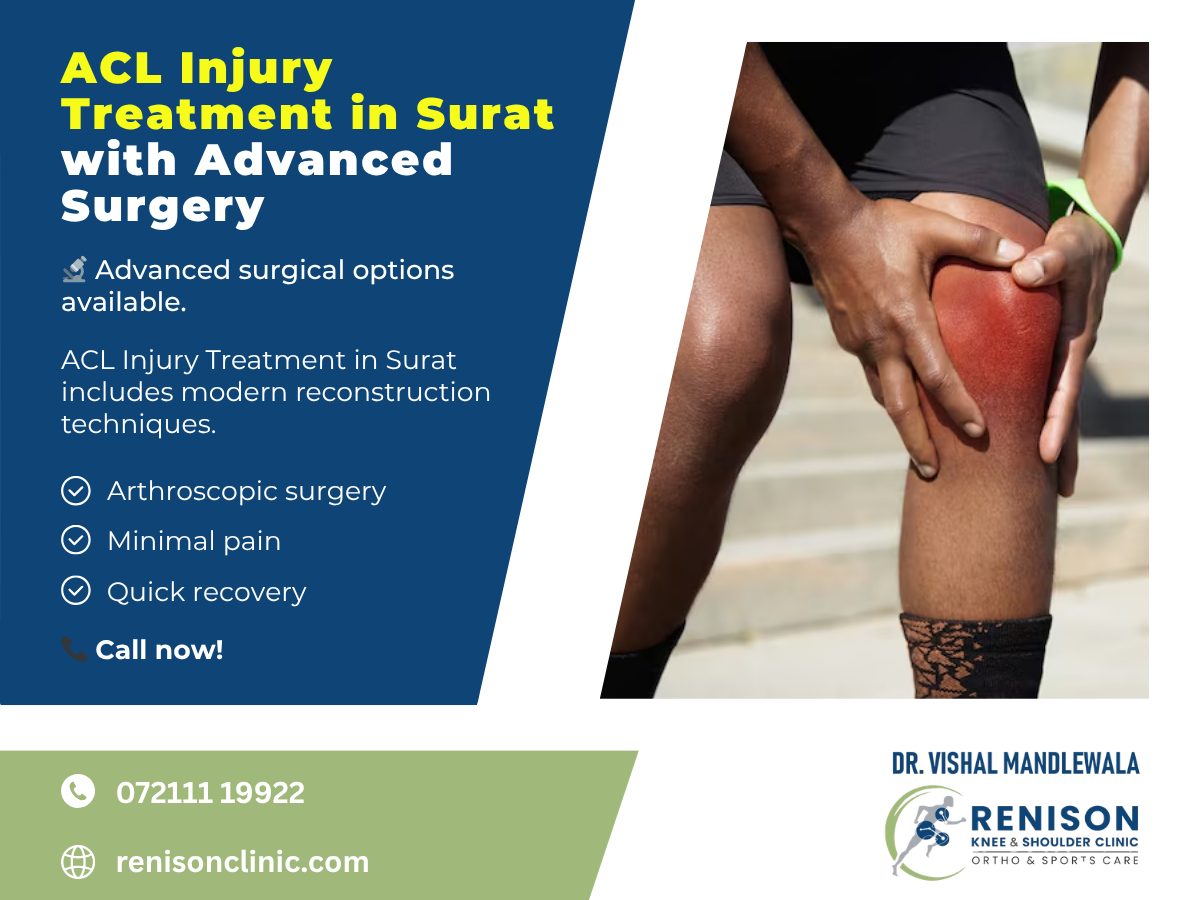
Surgical Treatment (ACL Reconstruction) For Grade 3 tears ; and Grade 2 tears in active individuals or athletes ; ACL reconstruction surgery is recommended. The torn ligament is replaced with a graft, allowing a new, strong ligament to regenerate. The procedure is performed arthroscopically through small keyhole incisions, ensuring minimal tissue damage, faster healing, and excellent long-term outcomes for patients seeking ACL injury treatment in Surat.
Can ACL Injuries Be Prevented?
While not all ACL injuries can be avoided, the risk can be significantly reduced by:
- Strengthening the muscles around the knee through targeted exercises
- Improving flexibility and balance through regular stretching
- Using proper technique during sports ; especially during landing and pivoting
- Wearing appropriate, well-fitted sports footwear
- Warming up thoroughly before any physical activity