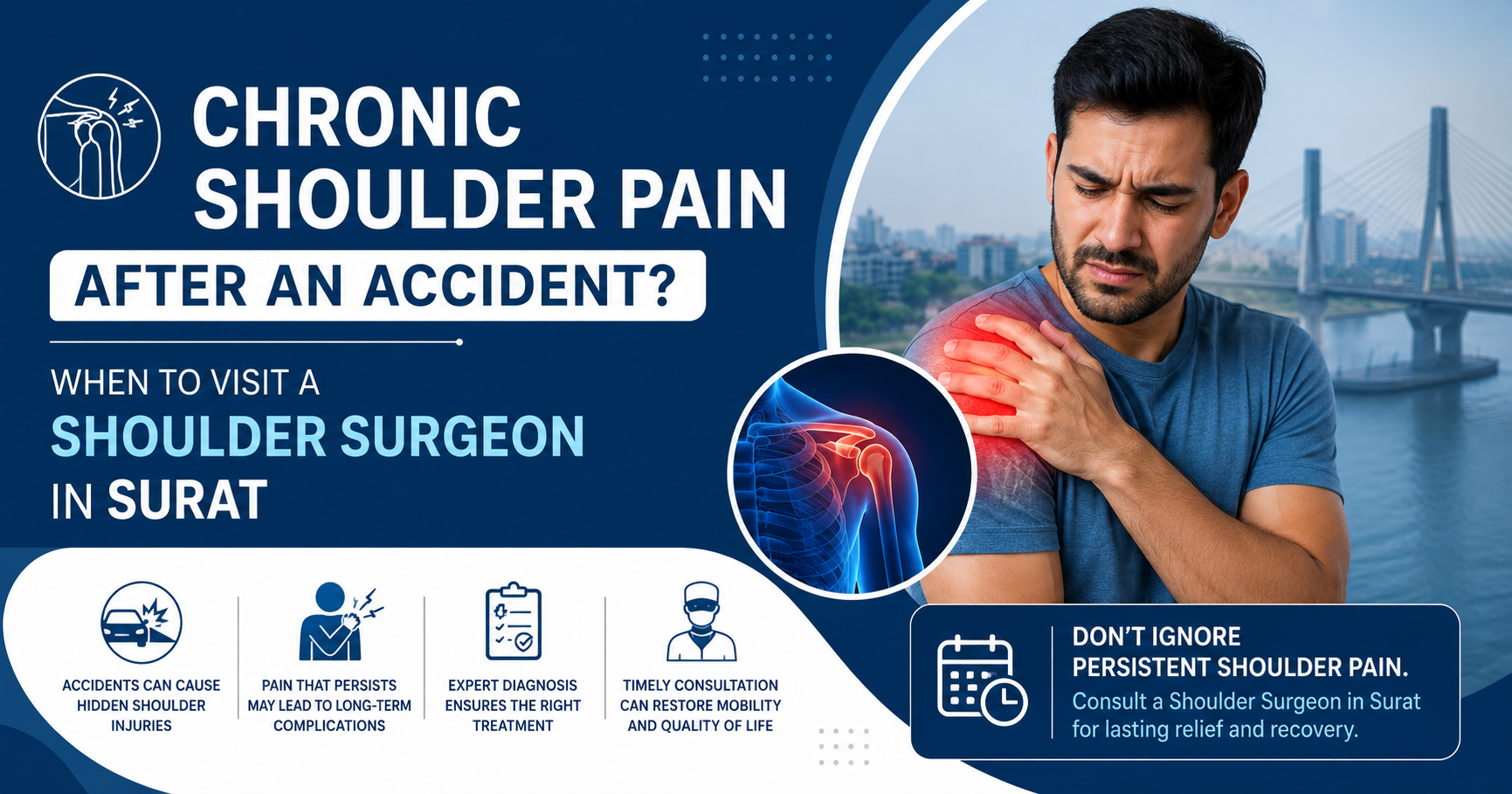
Chronic shoulder pain after an accident does not go away on its own – and waiting too long to seek treatment can turn a treatable injury into a permanent disability. If your shoulder has been painful, weak, or restricted for more than four to six weeks following a road accident, fall, or sports injury, it is time to consult a qualified shoulder surgeon in Surat for a proper diagnosis and treatment plan.
At Renison Knee & Shoulder Clinic, Surat, Dr. Vishal Mandlewala and his team see dozens of patients every month who ignored post-accident shoulder pain for months – sometimes years – before seeking care. The earlier you act, the better your chances of a full recovery.
Why Does Shoulder Pain Persist After an Accident?
Most people assume that shoulder pain after an accident is just bruising or a muscle strain that will heal with rest. While that is true for mild injuries, many accident-related shoulder conditions involve structural damage that does not heal without medical intervention.
The shoulder is one of the most complex joints in the human body. It allows a wider range of motion than any other joint, which also makes it highly vulnerable to injury. After a traumatic event – a car collision, a motorcycle accident, a fall from height, or a contact sports injury – the forces transmitted through the shoulder can damage muscles, tendons, ligaments, cartilage, and bone simultaneously.
When these structures are torn or disrupted, the body’s natural healing response is often insufficient. The result is persistent pain, stiffness, weakness, and instability that worsens over time if not addressed.
What Shoulder Injuries Are Commonly Missed After an Accident?
Rotator Cuff Tears
The rotator cuff is a group of four muscles and tendons that stabilise the shoulder joint. A sudden impact or forced movement during an accident can cause partial or complete tears. Partial tears are frequently missed on initial emergency X-rays and only become apparent on MRI. Symptoms include pain when lifting the arm, weakness, and a deep aching sensation at night.
SLAP Labral Tears
The labrum is a ring of cartilage that deepens the shoulder socket. A SLAP (Superior Labrum Anterior to Posterior) tear occurs when this ring is damaged, often during a fall on an outstretched hand or a sudden pulling motion. Patients experience a clicking or locking sensation, deep shoulder pain, and reduced throwing or overhead strength.
Shoulder Dislocation and Instability
A traumatic dislocation – where the ball of the shoulder pops out of the socket – is often treated in the emergency room and assumed to be resolved. However, a first-time dislocation stretches or tears the ligaments holding the joint in place. Without proper repair, the shoulder can become chronically unstable and dislocate repeatedly, particularly in younger, active patients.
Acromioclavicular (AC) Joint Injuries
The AC joint, located at the top of the shoulder where the collarbone meets the shoulder blade, is commonly injured in direct impacts or falls. AC joint sprains and separations are graded by severity. Higher-grade injuries may require surgical stabilisation to restore normal shoulder function.
Hairline Fractures
Not all fractures are visible on a standard X-ray taken in an emergency setting. Hairline fractures of the humeral head (ball of the shoulder) or glenoid (socket) can present as generalised shoulder pain and stiffness, and are often diagnosed only after a dedicated CT scan or MRI.
When Should You See a Shoulder Surgeon in Surat?
Not every shoulder injury after an accident requires surgery. However, there are clear warning signs that indicate you need to see a specialist rather than waiting for the pain to resolve on its own.
See a shoulder specialist immediately if you experience:
- Pain that has not improved after 4-6 weeks of rest and basic treatment
- Inability to raise your arm above shoulder height
- A visible deformity, bump, or asymmetry at the shoulder
- A feeling of the shoulder “slipping out” or being unstable
- Weakness when pushing, pulling, or carrying objects
- A constant grinding, clicking, or catching sensation during movement
- Numbness, tingling, or pins-and-needles extending down the arm
- Severe night pain that disrupts your sleep
Any of these symptoms following a road accident, fall, or sports injury should prompt a visit to a qualified shoulder surgeon in Surat without further delay.
How Is Post-Accident Shoulder Pain Diagnosed?
At Renison Knee & Shoulder Clinic in Surat, Dr. Vishal Mandlewala begins every assessment with a detailed clinical examination and a thorough history of the accident mechanism. Understanding how the injury happened is as important as the symptoms themselves, as it helps predict which structures are most likely damaged.
Clinical Examination
Specific physical tests assess range of motion, muscle strength, joint stability, and areas of tenderness. These tests help identify which structures are involved before any imaging is ordered.
Imaging Investigations
- X-Ray: Rules out obvious fractures and assesses joint alignment.
- MRI (Magnetic Resonance Imaging): The gold standard for diagnosing soft tissue injuries including rotator cuff tears, labral damage, and cartilage lesions. An MRI arthrogram (with dye injection) is even more sensitive for detecting labral tears.
- CT Scan: Best for assessing complex fractures and bony anatomy.
- Ultrasound: A useful bedside tool for dynamic assessment of rotator cuff tendons.
What Are the Treatment Options?
Conservative (Non-Surgical) Treatment
The majority of post-accident shoulder injuries are initially managed without surgery. Conservative treatment at Renison Knee & Shoulder Clinic may include:
- Targeted physiotherapy to restore mobility and rebuild muscle strength
- Anti-inflammatory medications and pain management
- Corticosteroid injections for persistent inflammation
- Activity modification during the recovery phase
Conservative treatment is given a defined trial period – typically 8 to 12 weeks – with regular review to assess progress.
Surgical Treatment
Surgery is recommended when conservative measures fail, or when the initial injury is severe enough that surgery offers the best chance of a full recovery.
Dr. Vishal Mandlewala specialises in minimally invasive arthroscopic shoulder surgery, which allows the surgeon to visualise and repair damaged structures inside the joint through small keyhole incisions. This approach means less post-operative pain, faster recovery, and lower risk compared to traditional open surgery.
Common surgical procedures performed at Renison Knee & Shoulder Clinic include:
- Arthroscopic rotator cuff repair – reattaching torn tendon tissue to the bone
- Labral reconstruction (Bankart/SLAP repair) – restoring the cartilage rim that stabilises the shoulder
- AC joint stabilisation – repairing the ligaments of the acromioclavicular joint
- Shoulder replacement – for severe fractures or end-stage joint damage in older patients
What Happens If You Delay Treatment?
This is perhaps the most important question to answer. Delaying treatment for a structural shoulder injury does not make the condition easier to treat – it makes it harder.
A partial rotator cuff tear, left untreated, can progress to a full-thickness tear and eventually become irreparable. Chronic shoulder instability causes progressive cartilage wear that can lead to early arthritis. Muscle wasting around the shoulder sets in quickly when pain prevents normal use.
Patients who seek care early – within the first few months of an accident – consistently achieve better outcomes, shorter recovery times, and a higher likelihood of returning to full activity. Those who wait years often face more complex surgery, longer rehabilitation, and less complete recovery.
Why Choose Renison Knee & Shoulder Clinic in Surat?
Dr. Vishal Mandlewala at Renison Knee & Shoulder Clinic brings focused subspecialty expertise in shoulder and knee conditions. His practice is built around accurate diagnosis, evidence-based treatment, and honest, patient-centred care.
Patients across Surat and South Gujarat trust Renison Knee & Shoulder Clinic because:
- Dr. Vishal Mandlewala holds advanced training in arthroscopic and reconstructive shoulder surgery
- The clinic offers dedicated MRI and imaging support for rapid diagnosis
- Each patient receives a personalised treatment plan – not a one-size-fits-all protocol
- The surgical team has experience across the full spectrum of post-accident shoulder injuries
- Comprehensive physiotherapy rehabilitation is integrated into the recovery pathway
If you or someone you know is living with unresolved shoulder pain after an accident, do not wait for it to get worse. Book a consultation with Dr. Vishal Mandlewala – a trusted shoulder surgeon in Surat – at Renison Knee & Shoulder Clinic today.