Introduction
Joint pain can start as a minor inconvenience – a dull ache after a walk, a click in your knee while climbing stairs, or a shoulder that refuses to lift properly. But for many people in Surat and across South Gujarat, that pain gradually becomes something that disrupts daily life, limits movement, and resists every non-surgical treatment attempted.
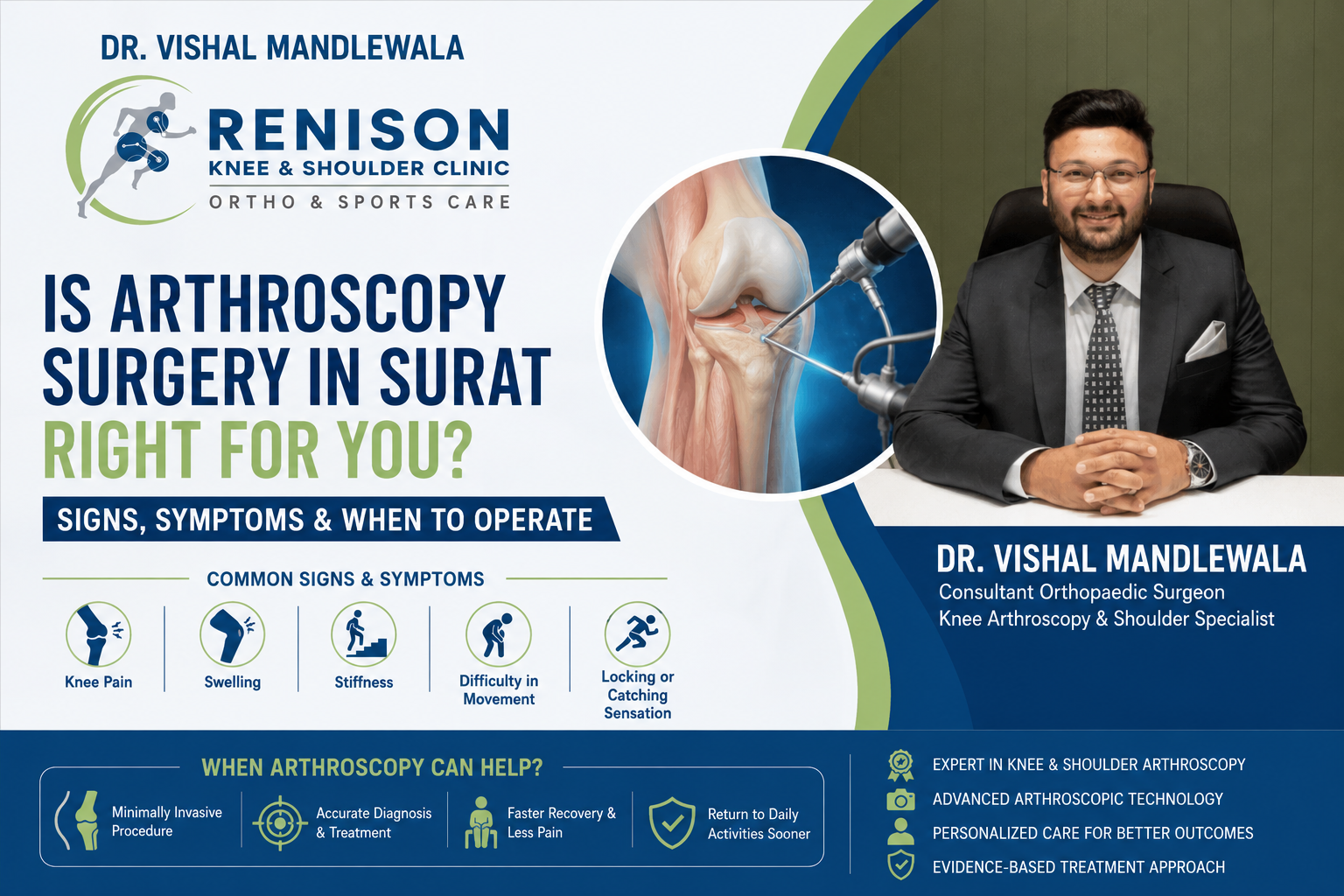
If you’ve reached that point, your orthopedic doctor may have recommended arthroscopy surgery in Surat as the next logical step. At Renison Knee & Shoulder Clinic, Dr. Vishal Mandlewala – a specialist in minimally invasive arthroscopic procedures – sees patients every week who ask exactly this question. But how do you know if it’s truly the right option for you? What symptoms actually warrant surgery? And what happens if you wait too long?
This comprehensive guide answers all of those questions – in plain language, with a clear focus on helping you make an informed decision.
What Is Arthroscopy Surgery? A Quick Refresher
Before diving into whether you need it, let’s briefly clarify what arthroscopy is.
Arthroscopy is a minimally invasive surgical procedure used to diagnose and treat problems inside a joint. A small camera called an arthroscope – roughly the size of a pencil – is inserted through a tiny incision into the joint. The surgeon views the interior of the joint on a high-definition screen and uses small instruments through additional incisions to repair, remove, or reconstruct damaged tissue.
Unlike traditional open surgery, arthroscopy involves:
- Smaller incisions (typically 3-5 mm)
- Less tissue damage
- Reduced post-operative pain
- Faster recovery times
- Lower risk of infection
Arthroscopy is most commonly performed on the knee, shoulder, hip, ankle, elbow, and wrist – all major joints regularly treated by orthopedic specialists in Surat.
Who Commonly Needs Arthroscopy Surgery in Surat?
Patients who benefit most from arthroscopy generally fall into one of these categories:
1. Athletes and Sports Persons
Surat has a growing community of recreational and competitive athletes – from cricketers and kabaddi players to gym-goers and runners. Sports activities put enormous repetitive stress on joints, making ligament tears, meniscus injuries, and rotator cuff damage common.
2. Working Professionals with Repetitive Joint Stress
Individuals in physically demanding occupations – construction workers, teachers who stand for long hours, or those who perform overhead tasks – frequently develop chronic joint inflammation and damage that eventually requires surgical intervention.
3. Middle-Aged Patients with Joint Degeneration
Cartilage wears down with age. Patients between 35-60 years who experience persistent joint pain not responding to physiotherapy, medications, or injections are often good candidates for arthroscopic procedures that clean up the joint and restore function.
4. Patients Who Have Had an Acute Injury
A sudden fall, accident, or twisting motion can cause immediate, structural joint damage – torn ligaments, fractured cartilage, or dislocated tendons. Arthroscopy is often required to assess the extent of the damage and repair it.
Key Signs & Symptoms That May Indicate You Need Arthroscopy Surgery in Surat
This is the section that matters most. Not every joint problem requires surgery. But certain signs, especially when they persist or worsen, are strong indicators that arthroscopic intervention is necessary.
Sign 1: Persistent Joint Pain That Doesn’t Respond to Conservative Treatment
If you have been managing your joint pain for 3-6 months or more with physiotherapy, anti-inflammatory medications, rest, and/or cortisone injections – and you’re still in significant pain – surgery may be the most effective path forward.
Conservative treatments are always the first step. But they have limitations. When the underlying structural problem (a torn ligament, a loose cartilage fragment, a frayed tendon) is not resolving, no amount of physiotherapy will permanently fix it.
Ask yourself: Has my pain significantly improved in the last 3 months despite treatment? Or does it keep coming back?
Sign 2: Joint Swelling That Returns Repeatedly
Occasional swelling after heavy activity is normal. But recurring swelling – where your knee, shoulder, or another joint regularly becomes puffy and stiff, especially without a clear trigger – is a warning sign.
Chronic swelling often indicates ongoing internal damage: fluid buildup from a torn meniscus, synovial inflammation, or a cartilage fragment irritating the joint lining. Arthroscopy allows the surgeon to directly identify and treat the source.
Sign 3: Mechanical Symptoms – Locking, Catching, or Giving Way
This is one of the clearest indicators for arthroscopic surgery. If your joint:
- Locks up suddenly and refuses to fully extend or bend
- Catches mid-movement with a sharp sensation
- Gives way or buckles when you put weight on it
then there is almost certainly a loose fragment, a torn meniscus, or ligament instability causing mechanical interference inside the joint. These symptoms rarely resolve without surgery.
Sign 4: Reduced Range of Motion That Limits Daily Activities
If you can no longer:
- Climb stairs without holding the railing
- Raise your arm above shoulder height
- Sit cross-legged or squat comfortably
- Walk for more than 10–15 minutes without stopping due to pain
This significant functional loss indicates structural compromise that arthroscopy can address.
Sign 5: MRI or Imaging Confirms Structural Damage
When your orthopedic surgeon in Surat orders an MRI and it reveals:
- ACL or PCL tears
- Meniscus tears (partial or complete)
- Rotator cuff tears
- Labral tears (shoulder or hip)
- Cartilage damage or loose bodies
- Synovitis (inflamed joint lining)
then you have objective, imaging-confirmed evidence of structural damage. Depending on the severity and your activity level, your surgeon will advise whether arthroscopy is the best next step.
Sign 6: Symptoms Are Affecting Your Work, Sleep, or Quality of Life
Pain is subjective, but its impact on your life is not. If joint pain is:
- Disrupting your sleep regularly
- Preventing you from doing your job
- Forcing you to give up activities you love
- Causing you to rely on painkillers daily
then the quality-of-life impact alone often justifies surgical intervention, particularly when conservative methods have already been tried and failed.
Sign 7: Your Condition Is Getting Progressively Worse
Some joint conditions are progressive. An untreated ACL tear doesn’t just stay the same – it can lead to meniscus damage, cartilage breakdown, and eventually early-onset arthritis. Similarly, an untreated rotator cuff tear can enlarge over time, making eventual surgery far more complex.
If your symptoms are worsening over weeks or months despite treatment, early intervention with arthroscopy can prevent long-term joint damage.
Conditions Most Commonly Treated by Arthroscopy Surgery in Surat
Knee Conditions
- ACL (Anterior Cruciate Ligament) Tear – Most common sports injury; arthroscopic reconstruction is the gold standard
- Meniscus Tear – Cartilage cushion damage; arthroscopy repairs or removes the torn portion
- PCL (Posterior Cruciate Ligament) Injury – Less common but equally impactful
- Cartilage Damage / Chondral Lesions – Smoothing or replacing damaged cartilage
- Loose Bodies – Fragments of bone or cartilage floating inside the joint
- Synovitis – Inflammation of the joint lining
Shoulder Conditions
- Rotator Cuff Tears – Partial or complete tears of the shoulder tendons
- Shoulder Impingement Syndrome – Pinching of tendons during movement
- Labral Tears (SLAP Lesions) – Tears of the ring of cartilage surrounding the shoulder socket
- Recurrent Shoulder Dislocation – Stabilization surgery to prevent future dislocations
- Frozen Shoulder (Adhesive Capsulitis) – Release of the tight joint capsule
Hip, Ankle & Other Joints
- FAI (Femoroacetabular Impingement) – Abnormal contact between hip ball and socket
- Hip Labral Tears
- Ankle Ligament Injuries
- Tennis Elbow (Lateral Epicondylitis)
- Wrist Ligament Injuries
When Should You NOT Opt for Arthroscopy? (Important Considerations)
Surgery is not always the answer, and a responsible orthopedic surgeon in Surat will always explore non-surgical options first. Arthroscopy may NOT be recommended if:
- Your imaging shows only mild, early-stage changes with no mechanical symptoms
- You have significant medical comorbidities (uncontrolled diabetes, heart conditions) that increase surgical risk
- You have a low-activity lifestyle and your symptoms are manageable with conservative care
- You have severe, end-stage arthritis, where joint replacement may be a better option than arthroscopy
- Physiotherapy has not been given an adequate trial (typically 3-6 months)
Key principle: Arthroscopy treats structural problems. If your pain is primarily inflammatory or degenerative without structural damage, other treatments may be more appropriate.
What to Expect: The Arthroscopy Surgery Process in Surat
Pre-Surgery Evaluation
Your surgeon will review your medical history, physical examination findings, and imaging (X-ray, MRI). Blood tests, ECG, and a fitness evaluation are standard pre-operative steps.
The Procedure
Most arthroscopic surgeries are performed under regional (spinal) or general anesthesia. The procedure typically takes 30 minutes to 2 hours depending on the complexity. You are usually admitted the day before or on the day of surgery.
Post-Surgery Recovery
- Day 1-3: Rest, ice, elevation; pain managed with medication
- Week 1-2: Wound care; gentle range-of-motion exercises begin
- Week 3-6: Active physiotherapy; progressive weight-bearing
- Month 2-3: Strengthening exercises; return to light activity
- Month 3-6+: Return to sports or strenuous work (for ligament reconstructions)
What Makes Surat a Good Choice?
Surat has several well-equipped orthopedic hospitals and clinics with HD arthroscopy towers, advanced imaging systems, and experienced surgeons trained in the latest minimally invasive techniques. Renison Knee & Shoulder Clinic, led by Dr. Vishal Mandlewala, is one of Surat’s dedicated arthroscopy centres offering precision joint care for knee, shoulder, hip, and other joints. The city also offers quality care at costs significantly lower than metro cities like Mumbai or Ahmedabad.
Frequently Asked Questions (FAQs)
Q1. Is arthroscopy surgery painful?
Arthroscopy is performed under anesthesia, so you won’t feel pain during the procedure. Post-operative discomfort is typically mild to moderate and is well-managed with prescribed pain medications. Most patients report significantly less pain compared to open surgery.
Q2. How long does recovery take after arthroscopy surgery in Surat?
Recovery varies by procedure. Simple procedures like meniscus trimming may allow a return to normal activity in 2-4 weeks. Ligament reconstructions (such as ACL repair) typically require 6-9 months for full return to sport, though most daily activities resume within 6-8 weeks.
Q3. What is the success rate of arthroscopy surgery?
Arthroscopy has a high success rate for appropriately selected patients. ACL reconstruction success rates are typically above 90% for restoring knee stability. Meniscus repair and rotator cuff repair also carry strong outcomes when performed by experienced surgeons.
Q4. Is arthroscopy surgery covered by health insurance in India?
Yes, most major health insurance policies in India cover arthroscopy surgery as it is considered a medically necessary procedure. Confirm with your insurer and your hospital in Surat to understand the claim process and documentation required.
Q5. Can I avoid arthroscopy surgery with physiotherapy alone?
In some cases, yes. Partial ligament tears, mild meniscus injuries, and early rotator cuff problems can often be managed non-surgically. However, complete tears, loose bodies, and structural instability generally do not resolve with physiotherapy alone and typically require surgical correction.
Q6. How do I choose the right arthroscopy surgeon in Surat?
Look for a surgeon with fellowship training in arthroscopy or sports medicine, significant hands-on experience (500+ procedures), modern facility infrastructure, and transparent communication about risks and outcomes. Dr. Vishal Mandlewala at Renison Knee & Shoulder Clinic in Surat specializes exclusively in knee and shoulder arthroscopy, offering patients expert, focused care with a patient-first approach.
Q7. Is arthroscopy surgery safe for elderly patients?
Arthroscopy can be performed safely in older patients if their overall health permits. The decision is made case-by-case based on medical fitness, severity of joint damage, and the expected benefit from surgery. Many elderly patients see significant improvement in mobility and quality of life post-procedure.
Q8. What is the approximate cost of arthroscopy surgery in Surat?
Costs vary based on the procedure, hospital, and implants used. Generally, arthroscopic procedures in Surat range from ₹40,000 to ₹1,50,000 or more for complex reconstructions. Surat is notably more affordable than Mumbai or Pune for the same quality of care.
Conclusion
The decision to undergo arthroscopy surgery is never one to take lightly – but neither is the decision to delay necessary treatment. If you are experiencing persistent joint pain, mechanical symptoms, confirmed structural damage on imaging, or a worsening quality of life despite conservative care, arthroscopy surgery in Surat may be exactly the right intervention at the right time.
The key is an honest, detailed consultation with a qualified arthroscopy surgeon who will evaluate your specific condition, review your imaging, and recommend surgery only when it is genuinely in your best interest.
If you’re in Surat or South Gujarat and experiencing any of the signs discussed above, don’t wait. Book a consultation with Dr. Vishal Mandlewala at Renison Knee & Shoulder Clinic, Surat – and take the first step toward pain-free living.